Showing posts with label MY PRISON DESIGNS SAGA. Show all posts

Friday, October 19, 2012

MY PRISON DESIGNS SAGA 5:

MARIANNA, FLORIDA 
FEDERAL CORRECTIONAL INSTITUTION  (1984-1986)

Marianna was probably my best design. It was a culmination of all my experience and the current correctional philosophy. It was reproduced for several facilities later.

I was aided by the architectural firm HLM of Orlando, Florida. It was a very exciting development of a new type of facility. 

I worked with the architects for over a year in developing this scheme. We had lots of input from various people and organizations. 


The Housing Unit was an especially intense design problem. The final design solved many desires of the many departments involved. 
It was reproduced for many federal and state facilities.


It was this facility that became the basis of my book on medium security correctional institutions for adults.


Since, it has won many accolades and rewards.


I was adapting it for a new site in Jessup, Georgia when I retired.


My other full institution designs were: Miami, Florida; Pleasanton, California; Camarillo, California; Jesup, Georgia; San Diego, California and Ray Brook, New York. (This one was very interesting because it housed the athletes for the 1980 Lake Placid Winter Olympics before becoming a prison—saving a lot of taxpayer money!)

I also did major renovation jobs at Leavenworth, Kansas; Milan, Michigan; Tallahassee, Florida; Englewood, Colorado; Lompoc, California; Atlanta, Georgia and in Puerto Rico.

Tuesday, June 26, 2012

MY PRISON DESIGNS SAGA 4:

MEMPHIS, TENNESSEE
FEDERAL CORRECTIONAL INSTITUTION (1980-1982)

Memphis was a federal correctional institution that I designed. By that, I mean, a medium security facility for adult inmates.

The correctional institution is a difficult design matter. It's an entire town within a security barrier. All aspects and interactions of a city are included: school, church, grocery store, offices, recreation, industries and housing.

Design is made more complicated by necessary security aspects: interaction, surveillance, organization and physical security. Protection must be maintained at all times for inmates, 
staff and the public.

Many other design aspects need to be considered: spacial relationships, functionality of spaces, relationship of certain functions to others, surveillance juxtaposition, efficient use of staff, and overall presentation to all people including the outside community.

Every aspect is designed with safety and security in mind. Also within the constraints of security, quality of the design to create an affable atmosphere is paramount. After all, 90% of the inmates will be back in society again and as much normalization as possible of the facility is conducive to good practices.
The Memphis Federal Correctional Institution brought all these aspects together producing a model facility used in other federal and state designs. My comprehensive book, as discussed earlier, was based on this facility.
Another Federal Correctional Institution: Ray Brook, N. Y. has an interesting twist. It was modeled on the Memphis facility but it was used as the athletics housing for the 1980 Winter Olympics in nearby Lake Placid! Entebbe had just happened at the Summer Olympics the time before, so everyone was concerned about security. Even the fence system was in place for the event. So it was constructed quickly with different functions for many areas. For instance, the commissary was a bank and the multipurpose room was a disco! It served its purpose well and afterward was converted to the FCI.

Next, The MARIANNA FCI.

Thursday, June 14, 2012

MY PRISON DESIGNS SAGA 3:

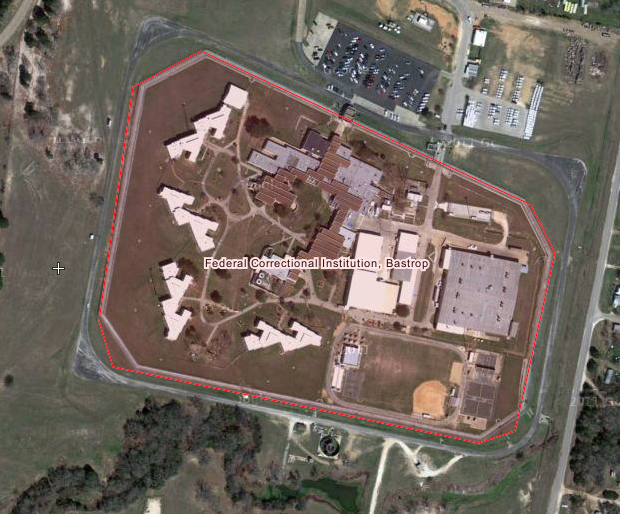
BASTROP, TEXAS 
FEDERAL CORRECTIONAL INSTITUTION (1975-1977)

This was an interesting project. It was for young adults—18 to 25. Therefore could be more colorful and playful than the rest.

Bastrop won an award for its solar energy plant. At the time, it had the largest square footage of solar panels in the world!
The award was given at the Waldorf-Astoria Hotel in New York City. I had to wear a tux! While entering the hotel, I saw President-elect and Mrs. Reagan! They were there visiting their son, Ron, before the Inauguration. Also on that night, across Central Park, John Lennon was shot. Yes, it was December 8, 1980.

Next, the MEMPHIS FCI.

Sunday, April 15, 2012

MY PRISON DESIGNS SAGA 2:

BUTNER, NORTH CAROLINA
FEDERAL MEDICAL CENTER  (1972-1974)

Butner was my first full, major institution that I designed. It was an exciting time, full of experimentation, forward-looking design and interaction with other professionals.

The architects were splendid. We had a very close relationship that meant the design itself turned into a superb facility—a model for other facilities.


It is a medical center, which means it houses medical, psychiatric and regular inmates. 


It makes for a very complicated design to house the various types of inmates. We gathered various experts from many fields, including Dr. Karl Menninger, to help us conceive of new designs. It resulted in housing a smaller group of inmates grouped around a central recreation area in each forty-inmate housing unit. This eventually became a universally accepted approach to housing all types of inmates. We succeeded in designing an overall facility that serves all functions excellently.


One interesting task was to develop a "bar-less" secure window. The experts felt it was imperative for psychological reasons. Thus began an 8-month investigation into the design of such a system. We enlisted many of the top industrial firms to help us. GE was the most helpful and devised a combination polycarbonite and glass sandwiched composite that was extremely secure. We tested many samples until we settled on a three-layer design. (We even had one design with an inner coating that was electrically conductive which would set off an alarm if disturbed. But it proved to be too expensive for wide-spread use. However, it is used commercially by Lincoln automobiles as material for the windshield that defogs and de-ices without wires in the glass!) We began using the three-layer composite in all our prisons as did the entire prison industry eventually.


Next, The BASTROP, TEXAS facility.

Sunday, April 1, 2012

MY PRISON DESIGNS SAGA:

MY PRISON ARCHITECTURE CAREER

Where do I begin? I guess at the University of Oklahoma Architecture School in the mid-60s.

But let me digress: I, Donald Cooke Voth, was born and raised in Oklahoma City. Dad always wanted me to be a doctor from the time I was a young boy. I had an aptitude for science and math but I never was very intrigued. Dad, a judge, always wanted to become a doctor, and I feel certain that he tried to instill that in me for that reason. I even graduated in pre-med at Westminster College in Fulton, Missouri. Then, I was accepted at St. Louis University Medical School. But when I got the bill for the cadaver, that stopped everything. It was an epiphany. I realized I really DID NOT want to be a doctor.

Then began a period of unrest and frenzy. My father got me a commission to the Naval Academy in Annapolis, Maryland. I didn't want to do that either. And finally one fateful day, I confronted by father with the fact that I had always wanted to be an architect. I thought that the shit would hit the fan. But he accepted it finally. Mom was ALWAYS for me, no matter what. 


Then it was off to Oklahoma University for a Masters in Architecture. Thank goodness my father didn't cut me off. I flourished in architecture school.


During my second year at the University of Oklahoma's Architecture School, I was a summer worker. My professor/employer called me into his office one day and said, "How would you like to go to Washington DC to work next summer?"

I said, "That might be interesting. To work for the bureau of, what did you say?"

"Prisons! The Federal Bureau of Prisons. I've sent two students there for summer jobs and they have ended up staying there. They want an apprentice to come next summer."

I thought it over and decided even though it was prisons, that I might be interested in doing that. I would, at least, be living in Washington DC which might be exciting!

The next summer found me there, working. 

BOP Headquarters.

The architects from Oklahoma were very nice and helpful. The work was engrossing and fulfilling; the city, exciting. They asked me to come back permanently after I graduated the next year! I was unsure but very interested.

By Christmas, I still hadn't made up my mind. They sent me to the Federal Correctional Institution in El Reno, Oklahoma, for a 
look-see and interview.
The people there could not have been nicer and it was actually very interesting. Although when that front grille-gate slammed shut with me inside, there were some doubts.

But I ended up deciding to work at the headquarters in Washington. It would be an actual supervised apprenticeship and I figured a bird-in-the-hand was worth two-in-the-bush.

So that started my 32-year career with the Federal Bureau of Prisons, US Department of Justice.

Overall, it was fascinating, exciting and fulfilling work

   ---that I dedicated my life to.

I always lived on Capitol Hill, where I could walk to work.


I wrote a comprehensive book on the subject of secure adult prisons. This took a lot of time out of a year of my work life, but I am very proud of it. It sold many copies through the National Institute of Corrections. It was very influential on future prisons throughout the world.

There are four prisons I would like to tell you about. On these four (and others) I worked with architects to design from the ground up, literally. Each one took about a year and a half of my career to accomplish.


Next, the first one of the four: Butner, North Carolina.